
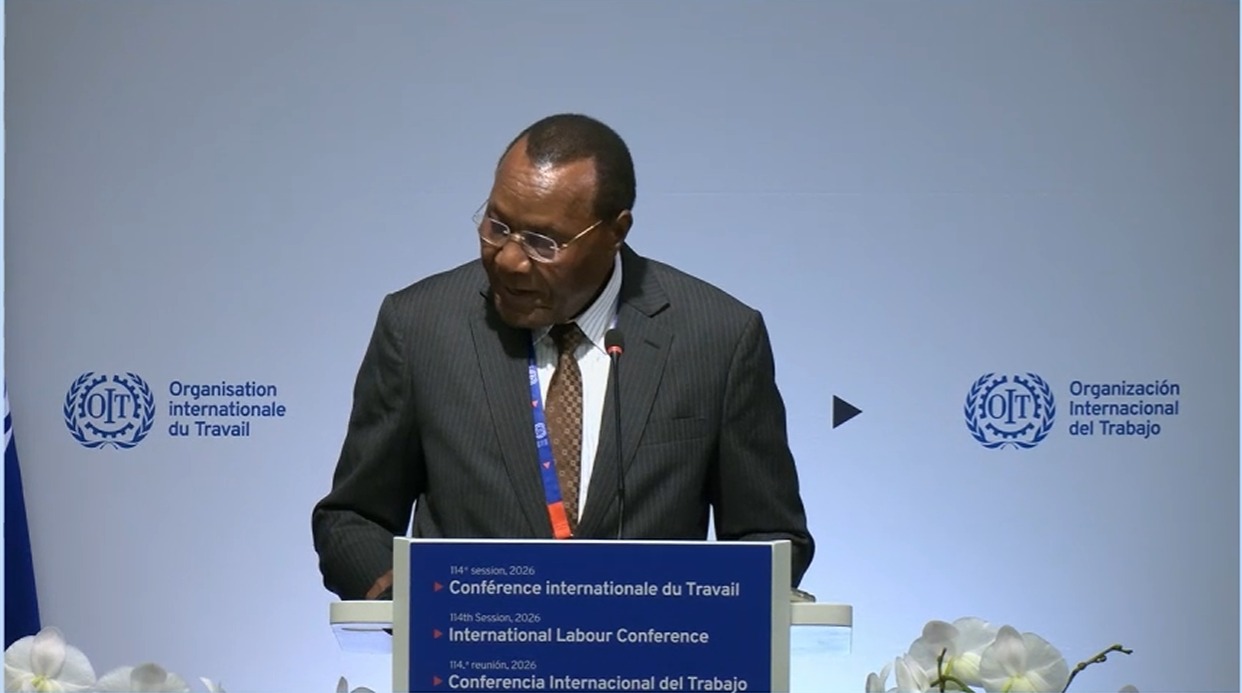
Uganda has called for a people-centred approach to technological transformation, warning that artificial intelligence must support workers, expand decent employment and strengthen national productivity rather than undermine the foundations of work.
The appeal was made during the 114th International Labour Conference, where delegates are examining the future of work, with particular focus on the impact of artificial intelligence on productivity, skills, employment and social justice.
Delivering Uganda’s statement, Ambassador Marcel Robert Tibaleka, the country’s Permanent Representative to the United Nations in Geneva, said technology must be designed to serve people and development goals.
“Technology should complement human work, reinforce skills development, improve productivity, and expand decent employment,” Tibaleka said.
He noted that artificial intelligence carries significant potential to boost productivity in sectors such as agriculture, health, education and industry. However, he cautioned that for developing economies, technological change must be matched with stronger labour market institutions, improved infrastructure, reliable energy systems, skills development, and broader stability.
Ambassador Tibaleka pointed to Uganda’s Fourth National Development Plan and its Tenfold Growth Strategy, which aim to expand the economy to 500 billion US dollars by 2040 through agro-industrialisation, tourism, mineral development, and science, technology and innovation.
He outlined several government programmes designed to promote enterprise growth and job creation, including the Parish Development Model, which channels about 260 million US dollars annually to parish-level enterprises; the 200 million US dollar GROW Project supporting women entrepreneurs; the National Apprenticeship Programme; Presidential Industrial Skilling Hubs; the Emyooga programme; and the Jua-Kali informal sector initiative.
“These programmes reflect Uganda’s conviction that decent work begins where people live, produce, trade and build their livelihoods,” he said.
He also informed the conference that recent amendments to the Employment Act, 2026, and the Occupational Safety and Health Act, 2025, are aimed at strengthening workers’ rights, improving workplace safety, and reinforcing the legal framework for decent work.
Ambassador Tibaleka further highlighted Uganda’s efforts to support refugees and host communities, noting that the country hosts more than two million refugees, the largest refugee population in Africa. He said initiatives such as the GROW Project are being implemented in partnership with the International Labour Organisation (ILO) to expand enterprise support for women entrepreneurs, including refugees.
He called for stronger international solidarity and enhanced support from the ILO to strengthen national systems for skills development, job creation, enterprise growth and social protection.
“At this moment of change, innovation must serve humanity, protect dignity and advance shared prosperity,” Tibaleka said.
